Ceramics And Polymers Contain A Sea Of Electrons

Ceramic Artists Inspired By Sea Life Google Search Pottery Ceramics Pottery Art

Bacteria Inspired Ceramics Google Search Pottery Sculpture Ceramic Art Ceramics

Ceramic Artists Inspired By Sea Life Google Search Organic Sculpture Organic Ceramics Ceramic Art

Beautiful Turquoise Sea Urchin Pottery Coquillage Pinterest Pottery Handbuilding Pottery Ceramic Clay

Ceramic Sea Turtles Twins Sculpted Tile 4x Por Medicinebluffstudio 38 00 Ceramics Pottery Art Pottery

D Krueger Botanical Art Ceramic Sea Urchin Sculpture Ceramic Art Sculpture Organic Ceramics Coral Sculpture

Many properties of metals are directly attributable to these electrons.
Ceramics and polymers contain a sea of electrons. Polymers and some ceramic materials covalently bond. Ceramics can typically withstand more brutal environments than metals or polymers. Positive atomic nuclei surrounded by a sea of delocalized electrons the blue dots. Of attraction between the metal ions and the delocalised electrons.
Chemical formulae metallic lattices do not contain fixed numbers of atoms. The characteristics of metallic bonds explain a number of the unique properties of metals. The nucleus of an atom contains which of the following particles. Held together by a surrounding sea of electrons valence electrons from the atoms.
For this reason polymers are very elastic e g a rubber band can be easily melted and have low strength. In metallic bonding a sea of electrons is uniformly distributed throughout the solid and acts as a glue to hold the atoms together. Metallic materials have large number of nonlocalized electrons i e. Of all the four types of bonds van der waals is the weakest.
Electrons are not bound to particular atoms. Van der waals bonds are relatively weak compared to the other three principal bond types and result when attractive forces from permanent or induced dipoles form. Density is a ratio of a. In ionic bonding a metal atom donates electrons and a nonmetal atom accepts electrons.
The percent ionic character ic of a bond between two elements a and b depends on their electronegativities x s according to eq 2 10. The electron sea model. In polymers there are covalent bonds between the atoms of the polymer but the polymeric macromolecules or chains are kept together by van der waals forces. Ceramics and glasses composites alumina al 2 o 3 wood silica sio 2 fibreglass silicon carbide sic carbon fibre composites silicon nitride si 3 n 4 filled polymers cements and concrete cermets metal ceramic metals have metallic bonding in which the outer electrons form a delocalised sea around the close packed metal cations.
Metals are combinations of metallic elements. This electron transfer creates positive metal ions cations and negative nonmetal ions anions which are attracted to each other through coulombic attraction. Metals are good conductors of electricity because the electrons in the electron sea are free to flow and carry electric current. Recall that the predominant bonding for ceramic materials is ionic bonding.
A protons b electrons c neutrons. Sharing of a sea of decoupled valence electrons. Ceramics are usually not good conductors of electricity or heat. A general disadvantage to metal casting is that the final product tends to contain more flaws and has a.
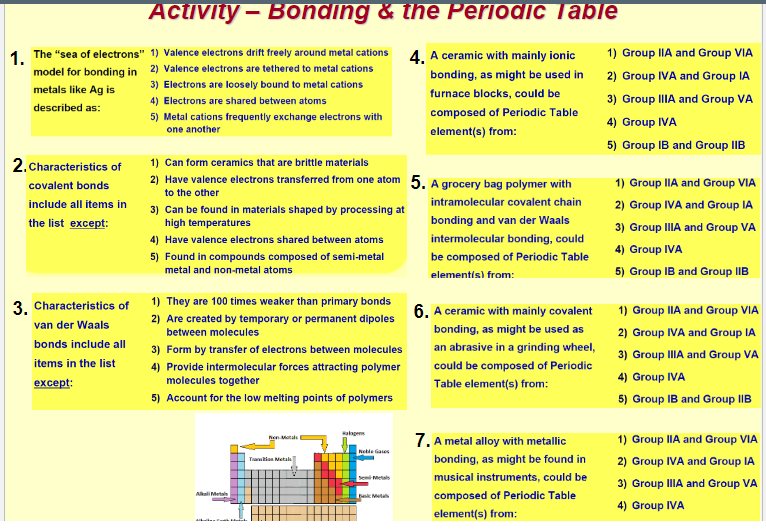
Solved Activity Bonding The Periodic Table 1 The Se Chegg Com

Quot An Electron Micrograph Showing That A Centriole Is Constructed From A Ring Of Nine Triplet Microtubules Most Animal Cells Contain Animal Cell Cell Image

Beautiful Sea Urchin Bowl Vase Pottery Art Ceramic Art Wheel Thrown Pottery

Art Deco Dutch Arnhem Art Pottery Mona Design Vase 1920 S Da1306031 Second Hand Art Pottery Art Art Deco Pottery

Pin On Poteries Et Sculptures

Image Result For Susan Beiner Tea Pots Art Ceramic Artists Tea Pots

This Item Is Unavailable Sea Creatures Ceramic Animals Tropical Beach

New Ceramics By Ikuko Iwamoto In Snug Sea Urchin Container Thorn Beaker 14 20 Ribosome Vase All Currently I Sea Sculpture Ceramic Art Contemporary Ceramics

Sea Life Clay Wall Sculpture Tile Handmade Nautical Three Dimensional Beach House Decor Hanging Sculpture Art Sea Urchin Decor Ceramic Wall Art Pottery Art Clay Wall

Elizabeth Shriver Sea Life Clay Art Projects Coral Wall Art Ceramic Art

Sakurai Yasuko Famous Ceramic Artists Ceramic Artists Pottery Sculpture

Delfina Emmanuel Ceramic Art Contemporary Ceramics Ceramic Sculpture

Gary Jackson Fire When Ready Pottery Clay Ceramics Ceramics Ceramic Pottery

