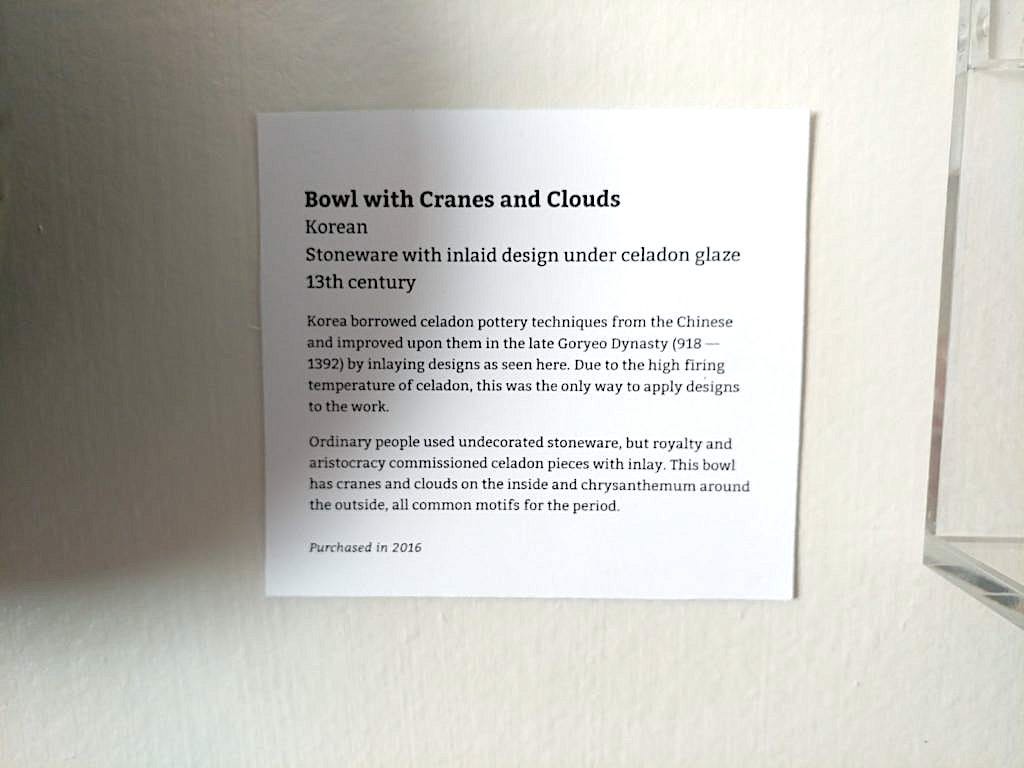
Ceramic Size Labels In A Museum

6928a1aded79c4856dba4aa13887dcf7 Jpg 442 500 Labels Museum Education Keyword Suggestion

Art Work Gallery Labels Ecosia Labels Exhibition Design Art

Classic And Straight Forward Exhibit Label Easy To Read Comfortable To Look At And Doesn T Distract From Label Templates Art Show Printable Label Templates
How To Make Your Own Home Museum Displays By Nick Gray Medium

How To Label An Exhibition Label Templates Art Show Price Artwork

Henri Matisse The Red Studio 1911 Red Studio Henri Matisse Museum Of Modern Art

There are some basic rules for applying labels and numbers to objects.
Ceramic size labels in a museum. Large sculpture may require that you place a label on the nearest wall or floor. In addition to being costly and time consuming for the curator to change paper museum labels labels are almost always also fixed in only one language and font size at a time. In his classic book interpreting our heritage first published in 1957 freeman tilden defines interpretation as an educational activity which aims to reveal meanings and relationships. Place object labels to the right if at all possible.
Separate museum storage from all other uses including office space and research and work areas. Museum storage areas must only house museum collections. Metal shell glass or ceramic are better than wood or leather 2 avoid numbering over paint or pigments. Unless your wall is as smooth as glass they are going to give you hell.
All report an average cost of 70 100 per label including design and labor with a single misprint or a change of text causing this cost to skyrocket. House collections in a dedicated space that has minimal penetrations and optimum thermal performance. Hang all labels at the same height and use a level to make sure they are parallel to the floor. Increasingly labels in non english speaking countries have labels in english as well as the main local language and in some parts of the world labels in three or more languages are common.
1 for objects made of more than one material choose the least porous surface. They look awful and usually end up curling at the edges and jumping off the wall after an hour or so. Makes the label appear to be floating also using a light spray adhesive makes the labels reusable. A museum label also referred to as caption or tombstone is a label describing an object exhibited in a museum or one introducing a room or area.
Keep in mind and ensure that labels are placed on the side of the artwork which will be approached first. Tilden emphasises that while interpretation includes information it also reveals larger truths about the world just. Museum storage space must be adequate to accommodate the particular. The national park service never uses fonts smaller than 24 points in their exhibits.
Labels within an exhibition should all be the same size unless there is need for longer explanatory text. 4 do not apply a stiff material to a flexible surface. I have found using black foamcore cut to a 45 degree angle and then just printing the labels and spray mounting them works really well. Make the labels a standard size and pull off the old paper and put the new ones on.
3 when in doubt use a tag. Place labels between eye level at 150cm to a lower height of 1m and within close proximity to the artwork they reference. Most museums have very specific guidelines for text labels. Size dimensions can be a bit superfluous in my opinion as for the physical labels steer clear of those printable self adhesive labels.

Museum Label Ganesha Remover Of Obstacles By Emily Barney Via Flickr Exhibition Plan Museum Labels

Pin On Artist Labels Gallery

Vincent Van Gogh Portrait Of Joseph Roulin 1889 Van Gogh Portraits Exhibition Design Design Museum

Examples Of Artwork Labels Label Templates Museum Displays Art Show

Museum Labels Flickr Label Templates Labels Art Business

What Typeface Is The Milwaukee Art Museum Milwaukee Art Museum Label Templates Museum

Pin By Irina Kosheleva On Museum Exposition Sign Display Exhibition Adriaen


Large Print Labels Moustier Ceramics Gifts From The Eugene V And Clare E Thaw Collection Cooper Hewitt Smiths Antique Ceramics Printing Labels Ceramics

Large Print Labels Moustier Ceramics Gifts From The Eugene V And Clare E Thaw Collection Cooper Hewitt Design Museum Printing Labels Design Department

Large Print Labels Moustier Ceramics Gifts From The Eugene V And Clare E Thaw Collection Cooper Hewitt Smithson Design Museum Antique Ceramics Drawings

Large Print Labels Moustier Ceramics Gifts From The Eugene V And Clare E Thaw Collection Cooper Hewitt S Antique Ceramics Printing Labels Design Museum

Museum Labels Labels Museum Sorbonne

